Hungary
The Zone of InterestHungary is presented as both a diplomatic battleground and the destination of a late, devastating deportation campaign. The Nazi leadership’s pressure on the Hungarian government moves from demands for discrimination and confinement to an ultimatum backed by the possible use of the Wehrmacht; in April 1944, despite Germany’s increasingly catastrophic military situation, troops are diverted to Budapest and close to half a million Hungarian Jews are deported and murdered in Kat Zet II. The contrast between the regime’s dwindling strength and its insistence on carrying out this campaign makes Hungary a measure of the persistence, and the self-justifying momentum, of Nazi persecution.
Hungary in the Nazi leadership’s calculations
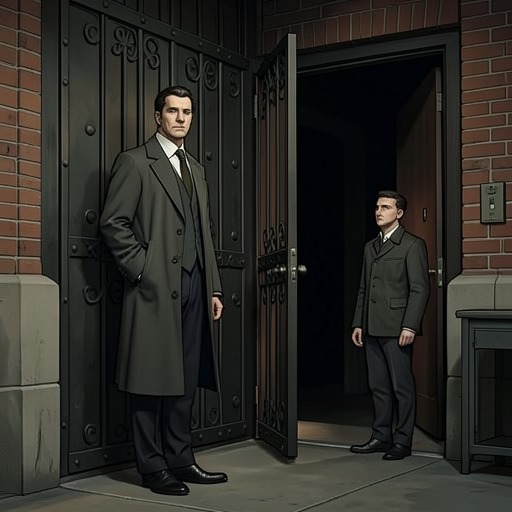
Martin Bormann’s remit includes Hungary and the question of its Jews. His nephew Angelus Thomsen waits in Berlin for an appointment with him, but seven, eight, or nine meetings are arranged and then cancelled by Bormann’s secretary, Wibke Mundt. She explains that Bormann is absorbed in diplomacy and has been meeting Hungarians. The repeated cancellations keep the Hungarian question in the narrative as a matter of high-level attention, even while Thomsen is left waiting for the Reichsleiter.
Hungary also appears against the background of competing Nazi administrative priorities. The Economic Administration Head Office presses for more labor in the munitions industries, while the Security Service presses for the disposal of evacuees. A teletype proposes putting able-bodied mothers to work in a boot factory at Chełmek; the objection is that officials have not considered the practical consequences of separating mothers from their children at the arrival ramp. This exchange does not describe a specific Hungarian measure, but it establishes the bureaucratic conflict between extracting labor and pursuing deportation that surrounds the regime’s treatment of the people it has placed under its power.
From central authorization to mass murder
A later conversation with Professor Peters places the persecution of Hungary’s Jews within a broader account of how extermination escalated. He dates the beginning of what he calls the crime without a name to July 31, 1941, when a letter drafted by Eichmann and Heydrich was sent to Goring and returned with his signature. The letter conveyed Hitler’s wish for a total solution and authorized action after manpower had been assembled in the east. The novel presents this as a moment of central authorization, but not as a complete operational blueprint for the later killing of women and children.
Peters describes an earlier possibility of expelling Jews to a cold, barren region beyond the Urals or inside the Arctic Circle after a rapid victory over Russia. That territorial answer recedes as Germany annexes another three million Jews and officials in Poland claim they cannot cope with the numbers. By August or September, pressure from below has intensified; the decisive change, in Peters’s account, is the extension of killing from men, who had already been murdered for months, to women and children. His explanation connects central direction with pressure among officials on the ground, rather than presenting the escalation as a single, fully specified decision from the outset.
The conversation also rejects the idea that industrial killing equipment was essential to the outcome. Peters calls the gas chambers and crematories means of speeding the process, economizing, and sparing the killers’ nerves; bullets and pyres, he argues, would have served the same murderous purpose. He cites the Einsatzgruppen’s killing of well over a million people by shooting and insists that the killers already had the will to murder millions more, including women and children. This account makes technology part of the method, not the source of the crime: the decisive element is the willingness to carry it out.
Berlin’s demands on Budapest
At a meeting with Hungarian representatives, Bormann presents Berlin as eager to strengthen its bond with Budapest, but immediately turns to what the Hungarian government has not done to satisfy Nazi demands. He condemns the policies of Prime Minister Kállay and portrays Hungary as a refuge for Jews, treating the presence of Jewish people across Europe as a threat to national security. His rhetoric disguises coercion as an appeal to alliance and security, while his references to earlier Hungarian political decisions underscore Berlin’s dissatisfaction with the government’s direction.
Bormann then specifies the measures Hungary is being asked to introduce in accordance with the Reich’s legal system: confiscation of Jewish wealth, exclusion from cultural and economic life, and the imposition of the Star. Jews are to be concentrated and quarantined, with dispatch to follow. He says he comes from the Wolf’s Lair with a personal greeting for Regent Horthy, whose recent visit had apparently failed to produce agreement, and warns that Germany will take Hungary’s Jews even if it has to use the Wehrmacht. The progression from confiscation to exclusion, concentration, and deportation turns the diplomatic meeting into an unmistakable threat of forced compliance.
Deportation in a collapsing Reich
The later account corrects the triumphant claim that Bormann got every Hungarian Jew. His aunt recalls his handling of the questions of people of mixed ancestry and Jews married to Germans, and says those who were intermarried were, for the most part, left alone. She then takes satisfaction in the claim that he got the Hungarians. The narrator qualifies it: not quite every one. This exchange preserves both the scale of the campaign and the limits of the boast, including the distinction between those targeted for deportation and those who survived.
As late as April 1944, the war was long lost, cities had been razed, and millions of people were half-starved, homeless, and dressed in singed rags. Yet the Reich diverted troops to Budapest, and deportations began. Close to half a million Hungarian Jews were deported and murdered in Aktion Doll in Kat Zet II, while two hundred thousand survived. The campaign’s timing makes the regime’s priorities stark: even amid military collapse and mass deprivation, resources were spent on deportation and murder.
The narrator compares this late campaign to a man in Linz who stabbed his wife 137 times, explaining each additional thrust as justification for the one before it. The image presents the Hungarian deportations as a policy sustained by its own previous violence: each further act is made to defend what has already been done. Bormann, according to his aunt, regarded the campaign as his greatest accomplishment on the world stage and his greatest contribution as a statesman. That recollection leaves Hungary linked not to the success of ordinary diplomacy, but to the regime’s ability to turn persecution into a claimed political achievement.